
The first time I noticed something was wrong, it was a Tuesday morning in a glass-walled conference room and the CMO was pointing at a screen.
The slide showed organic traffic down 38% year over year. The next slide showed revenue flat. The slide after that showed pipeline up 14%. He looked at me the way clients look at you when they want a story that ties three contradictory numbers into one explanation, and he asked the question I had been quietly dreading for about six months.
“So what is actually happening to us?”
I did not have a clean answer that day. I had a hunch, and I had a lot of half-formed theories, and I had the uncomfortable feeling that the dashboards I had spent a decade trusting were no longer describing the world I was working in. What I did not have was proof.
This post is the proof I wish I had brought into that room.
If you have been in SEO long enough to remember when ranking number one for your money keyword actually meant something, you already feel what I am about to describe. Traffic is falling. Revenue is not. Your dashboards say one thing, your sales team says another, and somewhere in the gap between those two stories is the most important channel you have right now, the one nobody on your team can see.
We are going to give it a name. We are going to learn why it is invisible. And by the end of this post, you are going to be able to walk into your own version of that conference room and explain exactly what is happening, with data, with a framework, and with the calm authority of someone who is no longer guessing.
The Channel That Does Not Show Up
Here is the simplest way I can describe what changed.
For twenty years, when somebody wanted to know something, they typed it into Google, they clicked a blue link, and your analytics platform watched it happen. Search engines were honest brokers about where their traffic came from. Referrer headers passed cleanly. Sessions were tagged. Channels were named. The map matched the territory.
Then ChatGPT happened. Then Claude. Then Perplexity. Then Google itself started answering questions in a box at the top of the results page, and people stopped clicking. Then those same people started asking ChatGPT to recommend an accountant, a SaaS tool, a destination wedding venue, a B2B vendor for industrial cooling systems. And when they finally did show up on your site, they showed up with no fingerprint, no referrer, no UTM, no story.
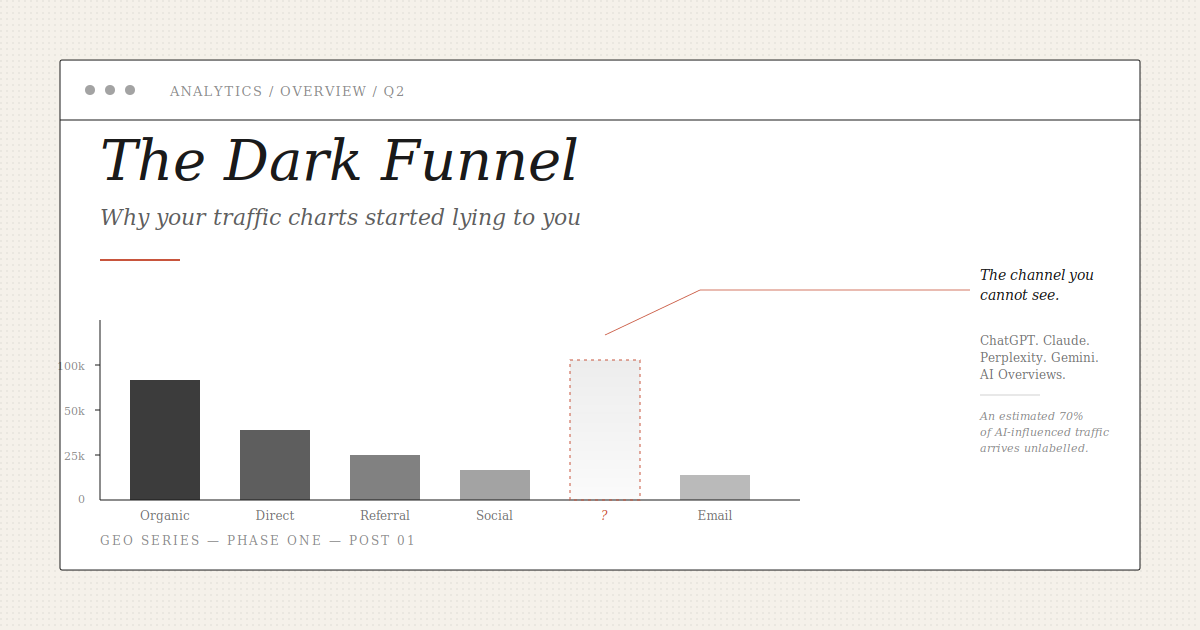
Analytics platforms call that bucket “direct.” It is supposed to mean someone typed your URL into a browser. In 2026, it mostly does not mean that anymore.
Seer Interactive ran an audit on a real client account and found that 64% of the top ten referral sources were dark, meaning the referrer was either stripped, overwritten, or never passed in the first place. Other recent studies put AI-influenced traffic misclassification at around 70%. Across the marketing industry, 64% of leaders openly admit they do not know how to measure AI search success. Half of B2B buyers say they now consult an AI tool before talking to a vendor, and almost none of those conversations leave a trace your CMO can point to.
This is what I have started calling the dark funnel. It is not a single missing report. It is an entire layer of buyer behaviour that exists between curiosity and conversion, and your analytics platform was never built to see it.
The dashboards are not broken. They are working exactly as designed. The problem is that they were designed for a world that no longer exists.
Why the Referrer Disappears
Let me get into the why for a moment, because this is the part most articles skip and it is also the part that earns you credibility when you explain it back to your boss.
When you click a link on a normal website, your browser sends along a small piece of metadata called the Referer header. (Yes, it is misspelled. The spec authors typoed it in 1996 and we have lived with it ever since.) That header tells the destination site where you came from. Analytics tools read it and assign the session to a channel. Simple.
LLM responses break this in five different ways, and you need to understand all five if you want to instrument for them properly.
The first is that most AI chat interfaces render citations inside the chat window itself, not as standard HTML anchor tags pointing out to the open web. When you click, the browser sometimes opens the link with no referrer at all because the link was rendered in a context the browser treats as untrusted or sandboxed.
The second is the rel="noreferrer" attribute, which a lot of AI products add to outbound links on purpose, partly for privacy and partly because they do not want to be blamed for low-quality traffic to publishers.
The third is HTTPS-to-HTTP transitions. Browsers strip referrer data when moving from a secure origin to an insecure one. Most AI products are HTTPS. If your site is not fully HTTPS, you have been losing referrer data from far more than just AI for years.
The fourth is in-app browsers. When somebody clicks a ChatGPT citation inside the ChatGPT iOS app, the link opens in an embedded web view that often does not pass referrers the same way Safari or Chrome does.
The fifth, and this one is increasingly common, is that the user does not click at all. They read the answer, absorb the recommendation, close the app, and Google your brand name twenty minutes later. The AI was the actual sales channel. Google gets the credit. SEO gets the budget cut.
All five of these route the same way in your analytics. They show up as direct.
Three Layers, Not One
Here is where I want to give you a framework that has held up across every client engagement I have used it on. The dark funnel is not one problem. It is three, and they each need a different lens.
Layer 1 is what I call pre-click influence. Somebody asks an AI a question. Your brand comes up in the answer. They never click the citation. They never visit your site that day. But three days later, when they finally start researching seriously, they Google your name directly, or they ask a colleague if they have heard of you, or they go to LinkedIn and look up your founder. The AI was the first impression. You will never see it in any analytics platform that exists.
Layer 2 is stripped-referrer clicks. They did click. The session did fire. But by the time it reached your analytics, the referrer was gone, and the session got dumped into direct alongside actual brand loyalists typing your URL by hand. The data is technically there. It is just unlabelled.
Layer 3 is agent-mediated visits. This one is newer and most teams have not even started thinking about it. Increasingly, AI agents are visiting pages on behalf of users. A user asks ChatGPT to compare three vendors. ChatGPT browses each vendor site, extracts the relevant facts, and presents a summary. No human session ever fires. The only evidence the visit happened is in your server logs, sitting in user-agent strings most marketing teams have never looked at.
If you only solve Layer 2, which is what most agency proposals I see in 2026 are trying to do, you have solved maybe a third of the problem. The other two layers require completely different instrumentation, and we are going to walk through them.
How I Actually Diagnose This in a New Account
When a client hands me a fresh account and asks me to figure out how much of their “direct” is actually dark AI, this is the routine I run. It is not glamorous. It works.
The first step is to filter direct traffic by landing page in GA4. Go to the Engagement report, set Session default channel group to Direct, sort by sessions. Look at what is on top. If the top direct landing pages are your homepage, your contact page, your pricing page, that is normal navigational direct. Real humans typing your URL or clicking a bookmark. Healthy. Boring.
If the top direct landing pages are deep informational URLs, like a long-tail blog post buried four clicks into your site, with no campaign data, mostly new users, and a session duration that suggests they actually read the page, you are looking at dark AI traffic. Nobody bookmarks a 2,400-word article on industrial valve corrosion. Nobody types that URL by hand. Somebody pointed those users there, and the somebody was an AI.
The second step is to pull your server logs. This is the step most marketing teams skip because it requires either developer access or a tool like Cloudflare’s bot analytics, but it is the single highest-signal move you can make. Filter by user-agent strings. The ones to watch right now are GPTBot, OAI-SearchBot, ChatGPT-User, PerplexityBot, Perplexity-User, ClaudeBot, Claude-User, Google-Extended, and Bytespider. Each one has a different signature and a different meaning. GPTBot fetches for training. ChatGPT-User fetches because a human just asked ChatGPT a question and ChatGPT is browsing your page in real time to answer it. The second one is gold. It is essentially a live signal that you are inside an active AI conversation.
The third step is to cross-reference. Look at which URLs are getting the most ChatGPT-User and Perplexity-User hits over the past 30 days. Then look at which of those same URLs are getting elevated direct traffic in GA4 within 48 to 72 hours of those bot hits. The correlation is your proxy for dark AI traffic. It is not perfect. It is the best instrument we have right now, and it is enough to put a credible number on a slide.
I worked with a B2B SaaS client last year, a workflow automation product in a niche I will not name. Their organic traffic was down 31% year over year. Pipeline was up 22%. The CMO was getting heat from the board. We ran this exact diagnostic. What we found was that ChatGPT-User had hit their comparison-style content (the X vs Y posts, the alternatives-to posts) more than 14,000 times in the previous 90 days. Their direct traffic on those exact URLs was up 340% over the same period. Branded search volume was up 28%. Demo bookings that mentioned “I heard about you from ChatGPT” in the free-text source field had gone from zero a year earlier to 41 in the previous quarter.
We did not need to ask whether AI was driving pipeline. The evidence was sitting in three separate systems, and once we lined them up next to each other, the story told itself. That presentation saved the SEO budget. More importantly, it changed what the team was actually optimizing for.
The Real Attribution Model
Once you can see the dark funnel, the next question is how you build a reporting model your CFO will trust. This is where I see most teams freeze, because the honest answer is that you cannot give them a clean single-source-of-truth dashboard. Not yet. Maybe not ever.
What you can do is build a triangulation model. Three signals, none of them perfect, all of them pointing in the same direction.
The first signal is branded search lift. Pull weekly branded query volume from Google Search Console going back 18 months. Overlay it against your AI citation count, which you can pull manually by running your top 30 buyer-relevant prompts across ChatGPT, Claude, Perplexity and Google AI Mode every week, or automate with a tool like Profound, Otterly, or Ahrefs Brand Radar. If branded search is rising as your AI citations rise, and the correlation holds across at least eight weeks, you have evidence. Not proof. Evidence.
The second signal is prompt-set performance. Define 30 to 50 prompts your actual customers ask AI tools. Do not guess these. Pull them from sales call recordings, from your support inbox, from the questions prospects ask on your first demo. Run them weekly across the four major AI surfaces. Track citation rate, brand mention rate, sentiment, and competitor co-mention. For B2B SaaS, anything above 20% citation rate across a relevant prompt set is healthy. Below 10% means you are functionally invisible in AI search and the rest of your SEO work is pouring water into a leaky bucket.
The third signal is self-reported source data. This is the cheapest and most underused instrument in the whole stack. Add one free-text question to your demo booking form. “Where did you first hear about us?” Do not give them a dropdown. Dropdowns force people to lie. Free text lets them tell you the truth, and the truth in 2026 increasingly contains the strings “ChatGPT,” “Claude,” “Perplexity,” “Gemini,” or “an AI tool told me.” Tag those responses. After 90 days you will have ground-truth attribution that no analytics product on the market can give you, and you will have it for free.
Stack those three signals next to each other and you have a defensible story. Not a perfect one. But the days of perfect attribution are gone, and the marketers who insist on waiting for the dashboards to catch up are going to lose their budgets before the dashboards arrive.
The Conversation With the CFO
Let me close with the part that actually matters, because everything I have just written is technical work in service of one outcome, which is your ability to walk into a finance review and not get your channel killed.
Stop showing organic sessions. They are no longer the right unit of measurement. They describe the old world.
Show AI-cited prompts, week over week. Show branded search velocity, indexed to the start of the year. Show demo bookings with AI-influenced discovery, segmented out from your other channels. Show the server-log evidence of AI crawlers hitting your highest-converting pages. Stack those on one slide and tell the room: the channel did not shrink, the measurement did. Here is the new measurement. Here is what it shows. Here is what we do next.
This is the conversation I should have been having in that glass-walled room two years ago, and could not, because I did not yet have the framework. I have it now. You have it now. We can keep going.
What’s Coming
I sat in that conference room thinking the problem was a reporting problem. It was not. The reporting was just the first place the rot showed up. Underneath the broken dashboards is a deeper shift, one that changes what your site needs to be before AI will recommend it in the first place.
Because here is the thing nobody tells you when they sell you on GEO. The reason ChatGPT is not citing you is not that your content is not good. It is that ChatGPT cannot tell who you are. You are not a recognized thing in its world. You are a string of text on a page.
In the next post, we are going to talk about what it actually takes to become a thing. Not a brand, not a keyword, not a URL. A thing. An entity. The kind of object an AI can grab hold of, remember, and recommend by name.
That is Phase 1, Post 2. I will see you there.
Next in the series: Entities, Not Keywords: Becoming a Thing That AI Can Recognize. Where we leave the measurement problem behind and start fixing the actual reason you are invisible.
Leave a reply