
A few months after the conference room story I told in the last post, I got pulled into a different kind of meeting.
This one was with a fintech founder who had built a genuinely good product. His team was smaller than his competitor’s. His funding was a fraction of theirs. His content team had published less, his backlinks were fewer, his domain was newer, and yet by every conventional SEO metric his site looked stronger. Higher domain authority on the scoring tool we both used. Better Core Web Vitals. Cleaner site architecture. More relevant content.
His competitor was beating him in ChatGPT seven times out of ten.
We ran the prompts together on a video call. “Best business banking for early-stage startups.” “Top alternatives to [the dominant incumbent in their space].” “Which fintech is best for Series A founders.” Over and over, the same competitor’s name came up. Confidently. Repeatedly. With the kind of natural recommendation that sounds like a friend giving advice.
He looked at me and said the thing I have now heard from at least a dozen founders in the last eighteen months. “I do not understand. I am objectively better. Why does the AI keep recommending them?”
I had to tell him something that took me a long time to accept myself. The AI was not making a judgment about which product was better. The AI was making a judgment about which company existed.
This post is about what it means to exist in the eyes of a machine. And what it takes to become a thing that AI can find, hold onto, and recommend by name.
Table of contents
What an Entity Actually Is
Let me start by stripping out the SEO technicalties because this is where most enthusiast get lost.
When you and I talk about a company, we use a word; “Stripe,” “Notion,” “the bakery on the corner.” The word is just a pointer. Behind the word, in our heads, is a rich web of associations. We know what the company does, who founded it, where it is headquartered, what it competes with, what people say about it, what its logo looks like, what its product feels like to use. The word is a handle. The thing the handle grabs is what philosophers and computer scientists call an entity.
Large language models do something similar, except they build their entities out of the patterns they have seen during training. When ChatGPT processes the word “Stripe,” it activates a constellation of associated facts and relationships. Founded by the Collison brothers. Payment processing. Competes with Adyen and Square. Headquartered in Dublin and San Francisco. Used by millions of businesses. Known for developer-friendly APIs. All of that is part of the entity Stripe in the model’s internal representation.
Now think about what happens when you type a query into ChatGPT and your brand is involved. If the model has a rich entity for your brand, the response can lean on real associations to give a confident answer. If the model has no entity for your brand, or a weak one, two things happen. The first is that the model will not bring you up unprompted, because it has no strong association to surface. The second is that even if the user types your exact brand name, the model may hallucinate facts about you, conflate you with another company, or give a vague answer that does not capture what you actually do.
This is what I had to explain to my fintech founder. His competitor existed as an entity in the model. He existed as a website. Those are two completely different things.
Why Keywords Stopped Working
The old SEO mental model went something like this. People type queries into Google. Queries contain keywords. If your page contains those keywords, especially in important places like titles and headers, and if enough authoritative sites link to your page, you rank for the keyword.
That mental model is not wrong for traditional search. It is still mostly how Google’s blue links work, even now. But it stopped working for AI search the moment language models started generating answers instead of retrieving documents.
Here is the difference. When somebody asks ChatGPT “what is the best business bank for a Series A startup,” the model is not looking for a page that contains those exact words in those exact places. It is composing an answer from its understanding of the entities involved. The entity business banking, the entity Series A startup, and the entities that match the role of good options in this category. The model retrieves brands by association, not by keyword match.
This is why so many SEOs are confused right now. Pages they spent years optimizing for specific keyword rankings are not getting cited even when those exact keywords appear in user queries. The keywords are no longer the unit of retrieval. The entities are.
There is a deeper version of this point worth lingering on. When an LLM generates a recommendation, it is not running a search index lookup against your page. It is asking itself a question that reads something like, what are the well-known entities in this category, and which ones have the strongest association with the qualifiers in the user’s question? If you are not a well-known entity, you do not enter that decision. You are not in the room.
Becoming an entity is not a content marketing task. It is an identity-recognition task. And the steps are different.
How Models Actually Learn What You Are
Before I tell you what to do, you need a working picture of where models get their entity knowledge in the first place. Because the strategy depends entirely on understanding the sources.
There are three places, roughly.
The first is the pre-training corpus. This is the giant pile of text scraped from the open web, plus licensed data, plus things like Common Crawl, RefinedWeb, books, code, and a long tail of other sources. When a model is trained, it reads all of this and builds its internal representations from the patterns it sees. If you are mentioned ten thousand times across reputable web pages, news outlets, and reference sources, the model builds a strong entity for you. If you are mentioned twice, you barely exist in the weights.
The second is the knowledge graph layer. This is structured data that has been deliberately curated, mostly by humans, into databases of facts. Wikipedia, Wikidata, Google’s Knowledge Graph, Bing’s Satori, and a handful of others. Models are increasingly trained or fine-tuned on these because the data is clean, fact-checked, and machine-readable. If you are in Wikidata with a clean entity record, you are in the model’s bones.
The third is retrieval at inference time. When you ask ChatGPT a question now, the model often runs a live web search through Bing, fetches a few pages, and uses them to compose a fresh answer. This is the layer most SEO advice focuses on, because it looks the most like traditional SEO. But it is the shallowest of the three. The answers retrieval generates are constrained by which entities the model already recognizes well enough to query for, which loops you back to the first two layers.
So when you do entity optimization, you are not playing one game. You are playing three. A long-term game of getting your facts into the corpus that trains the next generation of models. A medium-term game of getting yourself into the structured knowledge graphs the current generation references. And a short-term game of getting your live pages structured well enough to be picked up cleanly when retrieval happens in real time.
Most agencies sell you the third game and call it GEO. The first two are where the real leverage lives.
The Five Layers of Entity Existence
This is the framework I now walk every client through. Five layers, ordered from foundational to tactical. You build them in this order because each one supports the next.
Layer One is your entity home. Every recognized brand has one page somewhere on the web that the algorithms treat as the canonical source of truth about you. For most companies this is their About page or their homepage. The job of this page is to be the cleanest possible statement of who you are, what you do, who founded you, where you are based, what you compete with, and what categories you belong to. Most About pages are written for humans and read like marketing copy. The entity home needs to read like an encyclopedia entry written by someone who respects the reader’s time. Names. Dates. Categories. Relationships. Verifiable facts. This page is the anchor everything else points back to.
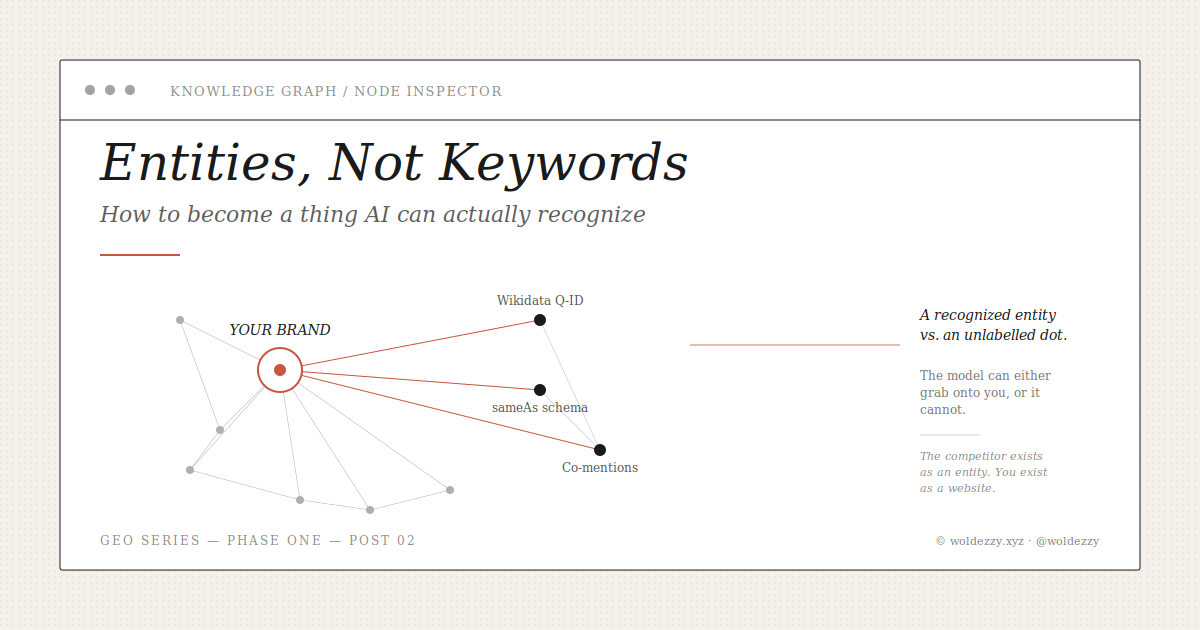
Layer Two is structured data. This is the schema.org markup conversation, but I want you to think about it differently than most SEO guides describe. The job of schema is not to “help Google understand your page.” The job of schema is to declare, in machine-readable format, this is who I am, here are my official identifiers, here is what I am connected to. The single most powerful piece of schema you can implement is the Organization type with a complete sameAs array. The sameAs property is how you tell the machine, this same entity exists at all of these other addresses. Your Wikipedia URL, your Wikidata URL, your Crunchbase URL, your LinkedIn company page, your Bloomberg or PitchBook profile, your verified social handles, your Google Business profile. Every one of those is a vote that says yes, this is the same entity, and yes, you can verify our facts at all of these external places. The more authoritative sources you can link yourself to through sameAs, the more confidently a model can resolve you as a real, distinct, verifiable thing.
Layer Three is presence in the structured knowledge layer. This is where most companies hit a wall, because it requires getting into databases you do not control. The big four are Wikipedia, Wikidata, Crunchbase, and Google’s Knowledge Graph. Wikipedia is the hardest because it requires editorial notability and independent secondary coverage. Wikidata is more accessible but requires patience and adherence to its conventions. Crunchbase is the most marketing-controllable but the least trusted by models. Getting a Google Knowledge Panel for your brand is the holy grail, and the most reliable path is through earning a Wikipedia entry first, because Wikipedia is one of Google’s primary signals for panel generation. If you cannot get a Wikipedia entry yet, focus on the components that lead to one: independent press coverage in publications Wikipedia considers reliable, third-party analyst reports, books or academic papers that cite you, and consistent biographical detail across the web.
Layer Four is co-mention density. This is the most underrated and most powerful layer. Models build entity associations by observing which things appear next to which other things across the corpus. If your brand is consistently mentioned alongside the top competitors in your category, the model learns that you belong in that category. If you are mentioned in comparison content, alternatives content, “best of” lists, and competitive roundups, you accrete category membership. This is not a hack. It is how the machine actually learns categories. The implication is strategic. You should be actively pursuing inclusion in the publications and content formats that list you next to the brands you want to be associated with. Guest posts in your industry’s trade press. Inclusion in independent comparison content. Mentions in podcasts and YouTube reviews that discuss your category. Every co-mention is a small vote for your entity’s category membership.
Layer Five is consistency. This is the boring layer that ruins everything if you neglect it. The same facts about you must appear consistently across every place a model might encounter you. Same founding year on Wikipedia, on Crunchbase, on your About page, in your schema markup, on LinkedIn. Same headquarters city. Same official product names. Same founder names spelled the same way. Same primary category. Inconsistencies are how models decide they are looking at two weakly-defined entities instead of one strongly-defined entity, and the result is that neither version of you wins. I have seen brands lose six months of entity progress because their LinkedIn page listed a different founding year than their Wikipedia article. The model resolved them as a confused entity and refused to confidently recommend them in any direction.
What I Did for the Fintech Founder
We spent the first month not writing any new content. None. Instead we did an entity audit. We mapped every place his brand appeared on the web. We found inconsistencies in seven different sources. We cleaned them up. We rewrote his About page to read like a clean entity description rather than a marketing pitch. We rebuilt his schema with a fully-populated sameAs array. We submitted a Wikidata entity for him, carefully, following the conventions, and got it accepted on the second attempt. We pitched two trade publications on inclusion in their upcoming “fintech for founders” roundups, and one of them said yes.
The next month we focused on co-mention. We got him onto three podcasts where he was discussed alongside his competitor. We published a comparison piece on his own site that named the competitor honestly and explained the differences without trashing them. We got listed in two independent alternatives directories.
Then we waited.
By the four month mark his ChatGPT citation rate for category-level queries had gone from 8% to 31%. By month six it was 44%. He is still smaller than his competitor. He still has less funding. But in the AI’s eyes he is now a real entity in the category, not a website with a confusing identity. The competitor still wins most queries. But they no longer win seven out of ten. They win four out of ten, and the difference is showing up in his pipeline.
The work was not glamorous. There was no clever content hack. We just made him exist properly in the machine’s world.
The Tension That Sets Up the Next Post
Here is what makes this work harder than it looks, and what I want you to carry into the next post.
The five layers I just described are not weighted the same across every AI platform. ChatGPT leans heavily on Wikipedia and a particular kind of structured authority. Perplexity leans heavily on Reddit and live web sources. Google’s AI Overviews lean on Reddit, YouTube, and Quora more than you would expect. Claude has its own quiet biases. The same entity-building effort gives you radically different results across these platforms, because the platforms are reading radically different parts of the web.
There is a fight happening right now about how to address this. One camp says you should publish a special file called llms.txt at the root of your domain to tell AI crawlers exactly what your site is about. The other camp, including some very senior voices at Google, says the whole concept is theater and does nothing. Both camps have data. Both camps are arguing in public. And the answer for your specific situation is more nuanced than either side is admitting.
That is Phase 2. The fault lines. The places where the GEO industry is openly fighting and where you, as someone trying to make real decisions about your real site, have to pick a side.
I will see you there.
Leave a reply